
November 24 update — Dell raises AI-server revenue forecast
Dell Technologies raised its fiscal 2027 AI-optimized server revenue forecast to $78 billion on November 24, up from $74 billion previously. It also increased its total annual revenue outlook from $192 billion to $202 billion.
For the quarter ended October 30, Dell reported revenue of $54.9 billion, an increase of 103% from a year earlier. The quarterly figures are reported results; the annual figures remain management forecasts and should not be presented as completed sales.
The announcement adds fresh supplier evidence to the AI-infrastructure spending story. It does not, by itself, establish the returns customers will earn from those investments or explain wider market movements.
Sources: Dell’s fiscal 2027 third-quarter results; Reuters, November 24.
Analysis
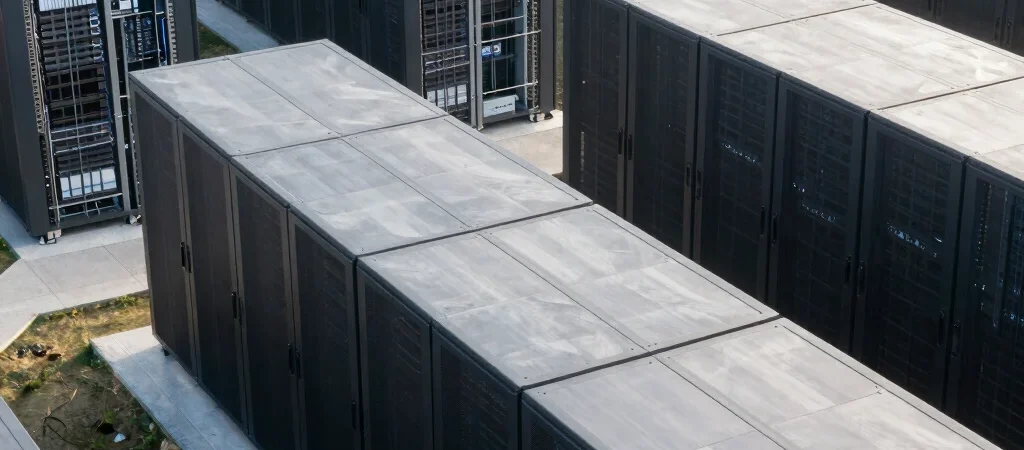
Illustrative server infrastructure; not identified as an Amazon facility.
Update — November 3, 2026
Oracle’s latest fundraising adds another measure of the financing behind the AI infrastructure expansion. Reuters reported that the company priced 86.2 million shares at $116 each, with roughly $10 billion expected from the equity offering and another $10 billion through debt.
Oracle said proceeds would support general corporate purposes, including capital spending, debt repayment, acquisitions, dividends and share repurchases. It would therefore be inaccurate to describe the entire $20 billion as earmarked exclusively for AI.
Separately, Reuters reported on November 2 that Alphabet launched a €6 billion bond offering. That report described pricing as expected later that day; it does not establish the final outcome of the sale.
The financing activity extends the investment debate beyond announced spending totals. Debt and equity provide different ways to fund expansion, with different consequences for interest obligations and shareholder ownership.
These announcements show companies seeking capital. They do not by themselves demonstrate that the resulting infrastructure investment will earn an adequate return.
Sources for this update
Reuters: Alphabet bond offering, November 2
The debate over artificial intelligence investment is becoming a debate about cash. Building a larger business can require enormous spending before the full financial benefits arrive—and investors are asking how long they will have to wait.
Reuters reported on October 30 that disappointing Amazon and Intel results intensified concerns about AI-related expenditure and helped drive a sharp decline in U.S. technology shares. A market reaction, however, is only one part of the story.
Amazon illustrates the tension
In its third-quarter earnings release, Amazon reported revenue of $201.9 billion and operating income of $28.1 billion. Its AWS cloud business generated $46 billion in quarterly sales, up about 39% from a year earlier.
At the same time, free cash flow for the preceding 12 months was negative $42.4 billion. Amazon attributed the decline primarily to increased property and equipment purchases, largely reflecting AI investment. It maintained a forecast of approximately $220 billion in cash capital expenditure for 2026.
Those numbers measure different things over different periods. Quarterly operating income should not be directly compared with trailing-12-month free cash flow as though both described the same accounting window.
Growth does not answer every investment question
Revenue shows what customers pay for products and services. Operating profit accounts for operating expenses under accounting rules. Free cash flow considers cash generated by operations after capital expenditure, using the company’s stated definition.
A business can report operating profit while spending even more cash on facilities and equipment. That situation does not, by itself, establish that the investment is unsound. It does make the timing and durability of future returns more important.
Investors must consider whether today’s capacity will attract enough profitable demand over its useful life. They must also consider what happens if customer demand grows more slowly than expected, equipment needs replacing sooner, or deployment takes longer than planned.
The company’s case deserves attention too
Amazon’s management says its AWS infrastructure investment is producing growth. The reported increase in cloud sales gives that argument substance, although AWS revenue should not be treated as a separate measure of AI revenue: the cloud business serves a broader range of computing needs.
The analytical question is therefore more precise than whether AI is popular. It is whether the additional earnings and cash generated by an investment justify its cost and risk.
What the next results need to show
Future earnings reports can help answer three questions: is customer demand converting into revenue, is that revenue generating attractive profit, and is the business moving toward cash generation after investment?
Capital spending should also be read alongside management’s explanation of what is being built and when it can serve customers. An announced project and a functioning facility represent different stages of an investment.
For smaller businesses adopting AI, the same discipline applies on a modest scale. A subscription or automation project should earn its place through measurable improvements in time, cost or output quality.
The current scrutiny reflects a demanding test for the industry: turning technical expansion into durable business returns.
About this byline
CliquePress Editorial Desk is the shared publication byline of Clique Digital Media and Marketing, LLC, covering world affairs, business, technology and culture. Articles may be prepared with AI assistance. About our editorial desk · Editorial standards and corrections · Report an error