
November 13 update — UN warns of rising shipping incidents around Hormuz
A United Nations briefing on November 13 called for safe passage through the Strait of Hormuz and neighboring waters after October recorded the highest monthly number of commercial shipping incidents since the conflict began. The UN cited 25 seafarer deaths through November 11, a toll the International Maritime Organization had already reported. The IMO’s published register lists 136 confirmed incidents across the strait and the wider Middle East maritime area through November 11.
United Kingdom Maritime Trade Operations rated the threat in the strait severe in its report for the week ending November 13. On November 14, Al Jazeera reported that Iranian authorities said three oil tankers had struck mines and caught fire. The account remains unconfirmed by independent maritime authorities in the sources reviewed. The IMO tally ends on November 11.
UN Security Council briefing · IMO incident register · UKMTO weekly report · Al Jazeera
November 11 update: Reuters sources corroborate attack on navigation systems in Hormuz
Three people with knowledge of the incident told Reuters on November 11 that Iran attacked maritime navigation systems on Oman’s Didamar Island in the Strait of Hormuz. Iranian state media had attributed the operation to the Islamic Revolutionary Guard Corps the previous day and claimed that equipment was destroyed. The Reuters reporting identifies the island and corroborates that the systems were targeted. The sources gave no damage assessment, and Reuters could not independently verify whether any equipment was destroyed.
Two shipping sources and a maritime security source told Reuters they expected a limited effect on commercial shipping. One pointed to other navigation systems elsewhere in the strait. That is an assessment of the likely effect. Actual disruption remains to be measured through notices to mariners and commercial vessel movements over a defined period.
Reuters report via MarketScreener
November 12 update: Crew evacuated after vessel strike off the UAE
An unidentified projectile struck a vessel off Ras Al Khaimah, United Arab Emirates, on November 11 and started a fire in its engine room, Reuters reported on November 12, citing maritime agencies. United Kingdom Maritime Trade Operations said all crew members had been evacuated and firefighting was underway.
Maritime security firm Ambrey said the vessel was struck as it was leaving the Strait of Hormuz and reported no injuries or pollution at the time. The reports did not identify who fired the projectile or establish a connection with the reported damage to navigation aids in the strait.
Reuters on the vessel strike and evacuation · UKMTO incident notices
November 9 update: Tanker reports projectile strike as Iran claims navigation aids were destroyed
United Kingdom Maritime Trade Operations said on November 8 that it had received a delayed report of a tanker being struck by an unknown projectile as it sailed outbound through the Strait of Hormuz. The tanker’s company security officer told UKMTO that all crew members were safe and accounted for. The notice said there was no reported environmental impact at the time and advised vessels to proceed with caution while authorities investigated.
Separately, Reuters reported on November 9 that an unnamed Iranian Revolutionary Guard naval official told state media that navigation aids in the southern part of the strait had been destroyed. The official also claimed that no vessels Iran considered unauthorized had passed through the waterway overnight. The available UKMTO notice does not confirm damage to navigation aids or establish a connection between the tanker incident and the Iranian statement.


What the tanker notice establishes
The UKMTO alert identifies the vessel as a tanker and describes it as travelling outbound. It attributes the account of the strike to the company security officer and identifies the object only as an unknown projectile. That leaves its type, origin and the circumstances of the strike open. The information about crew safety and the absence of a reported environmental impact reflects what was known when the notice was issued. A later vessel inspection or investigation could provide a fuller account of any damage.
The notice also describes the report as delayed. November 8 is the date of the alert. The public wording does not establish that the strike occurred on the same date or during the overnight period referred to by the Iranian official. That timing distinction matters when several reports emerge close together. A date attached to an alert tells readers when the information entered the public record, while the event time has to come from the incident details or subsequent reporting.
UKMTO advised ships to transit with caution and report suspicious activity. Its alert is a source for what was reported about this vessel and for the advice issued at the time. The notice provides no count of ship movements through the strait. Assessing the effect on commercial traffic requires broader information about vessels using the route, including whether ships are delaying passages or changing their schedules.
What Iran says about navigation aids
Reuters attributed the claim about destroyed navigation aids to an unnamed Revolutionary Guard naval official speaking to Iranian state media. The account places the reported damage in the southern part of the strait. The public reporting leaves the affected equipment, its exact location and any replacement arrangements unclear. Identifying those details would help mariners and shipping companies assess whether the reported damage affects a particular approach, a navigational reference point or a broader stretch of water.
The official’s statement about vessel movements referred to vessels regarded as unauthorized. The statement gives no total count of commercial crossings and does not independently establish the operating status of the passage. A shipping assessment would need observations over a defined period and enough detail to distinguish commercial vessels from other traffic. It would also need a comparison with earlier passages to measure any change.
Navigation aids can give crews reference points for finding and following a safe route. The practical effect of damage depends on the aid involved and the information available to crews through other systems and notices. A report about a specific aid can be evaluated against its charted position and purpose. Without those particulars, the consequences for a ship planning its passage remain uncertain. A subsequent notice identifying affected aids or amended routing instructions would provide a stronger basis for an operational assessment.
How the developments could affect shipping decisions
The Strait of Hormuz connects the Persian Gulf and the Gulf of Oman. For operators sending tankers through the passage, a report of a strike on an outbound ship adds information about a specific voyage. Reports involving navigation equipment raise a different question about the information crews rely on during passage. The two issues can both factor into an operator’s review of the route even while investigators work to establish what occurred.
The most immediate changes may show up in individual voyage decisions. An operator could reconsider departure timing, communicate with crews about a new alert or seek updated information before entering the strait. Those actions can be specific to a ship, cargo or company. Establishing an effect on shipping across the region would require evidence from several operators, reliable traffic observations or a public advisory that applies to a wider group of vessels.
Traffic counts can help distinguish a short pause from a sustained decline in crossings. Arrival records can help show whether a delay at the strait carried over to a port or delivery schedule. Insurer or operator statements could reveal whether the incidents have changed the commercial terms for a voyage. A single alert can prompt a reassessment, but changes in shipping costs and delivery timing should be reported with their own dates and sources.
What would materially change the picture
An investigation could identify the projectile or document damage to the tanker. A maritime authority could specify which navigation aids are affected and issue instructions for the relevant part of the route. Verified shipping data or statements from operators could show whether passages have slowed, resumed or shifted over a defined period.
When comparing traffic across periods, the direction of travel is relevant. The tanker report concerns an outbound passage from the Gulf. A wider account of disruption would need to show what happened to inbound vessels as well, and whether movements recovered after any immediate response. Separate figures for tankers and other ships would help distinguish a change affecting particular cargoes from a broader reduction in transit. A change in crossings would also need to be considered alongside the dates of other shipping advisories and incidents before it could be attributed to the reported damage.
The latest UKMTO notice establishes that the tanker operator reported a strike and said its crew was safe. The Iranian official’s statement adds a separate claim about navigation aids and overnight transit. The investigation, navigational notices and vessel traffic data can each answer different questions as more information becomes public.
Sources — UKMTO incident listing, report #200 · Reuters.
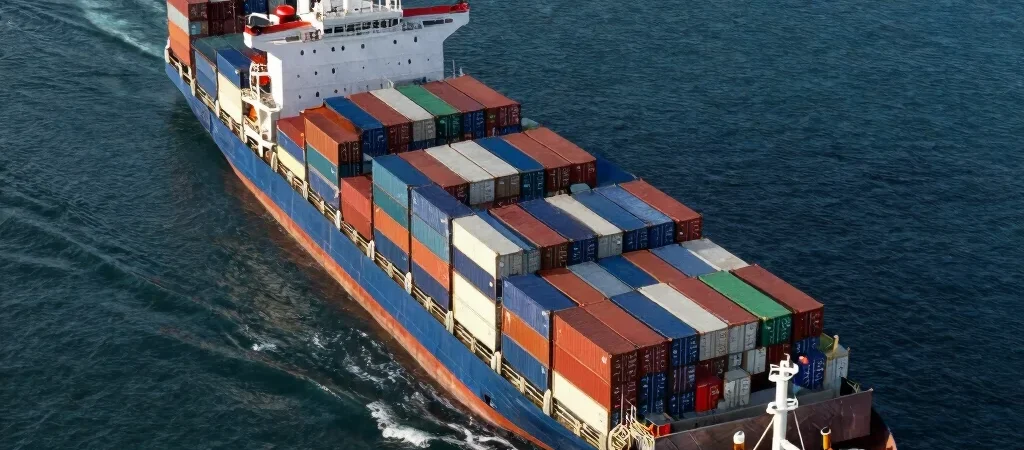
Illustrative port scene; not the reported tanker incident.
Update — November 3, 2026
Mediation continued between Iran and the United States after Iranian negotiators left Doha, but a senior Iranian official told Reuters on Tuesday that the sides remained far from an agreement.
Qatar’s foreign ministry said both countries were reviewing proposals from mediators. The diplomatic activity had not established an agreement to restore normal shipping through the Strait of Hormuz.
The talks continued after US strikes on Iran’s Qeshm Island. US officials described the strikes as defensive; one said they appeared limited and did not indicate a return to major combat operations. Those descriptions should remain attributed to the officials.
Separately, ADNOC chief executive Sultan Al Jaber said on November 2 that nearly one billion barrels had been drawn from global oil inventories since the disruption. This is his estimate of the effect on supply buffers, rather than an independently calculated CliquePress figure.
The developments show diplomacy continuing alongside military and energy-supply risks. They do not establish that the waterway has reopened or that shipping conditions have normalised.
Sources for this update
Reuters: oil inventory estimate, November 2 · Reuters: Doha talks, November 2
Update — November 1, 2026: Diplomatic talks continue in Doha
Iranian negotiators continued discussions with Qatari mediators in Doha on Sunday, an official briefed on the talks told Reuters. The negotiations aim to reach an agreement to end the conflict involving Iran, the United States and Israel.
Iranian Foreign Minister Abbas Araqchi said consultations were progressing, but no final agreement had been reached on the proposal under discussion. The diplomatic activity therefore does not establish that the Strait of Hormuz has reopened or that normal shipping conditions have returned.
Renewed reports of tanker incidents in the Strait of Hormuz have brought a familiar vulnerability back into focus: energy trade depends on a small stretch of water.
Al Jazeera reported on October 30 that Oman rescued 25 crew members from a burning tanker. The report highlights a broader question: how can trouble in one sea passage affect costs thousands of miles away?
Why Hormuz is difficult to replace
The strait connects the Persian Gulf with the Gulf of Oman. The U.S. Energy Information Administration’s chokepoints analysis estimates that oil flows through it averaged 20.9 million barrels a day in the first half of 2025—roughly one-fifth of global petroleum liquids consumption. That is a historical baseline, not a measure of current traffic.
More recent EIA data estimate flows of 4.9 million barrels a day in the second quarter of 2026, compared with 21.6 million in the final quarter of 2025. The agency cautions that tracking signals have become unreliable and estimates are subject to revision. These quarterly figures do not establish conditions on any particular day in October.
Some oil can move through pipelines that bypass the passage, but the EIA says alternatives can accommodate only part of the volume. Liquefied natural gas also relies on the route, especially exports from Qatar.
That makes Hormuz different from a simple road detour. A ship already inside the Gulf cannot reach the open ocean by sailing around another continent. Alternative infrastructure must exist, have spare capacity and connect the cargo to an appropriate export terminal.
How shipping risk becomes an economic cost
The EIA warns that chokepoint interruptions can delay supplies, raise shipping costs and push energy prices higher. An interruption does not have to last indefinitely to matter: uncertainty over when cargo will arrive can complicate planning.
First, a buyer faces uncertainty about delivery. Next, the companies involved must decide whether to wait, find another supplier or adjust operations. Those choices can carry costs before a shortage reaches the final customer.
This does not mean every incident produces an immediate increase in supermarket prices. Inventories, supply contracts, taxes and exchange rates influence how quickly international pressures reach local bills.
Why readers outside the region should pay attention
For an importing business, the useful question is exposure: does it buy fuel, purchase energy-intensive goods or rely on transport whose costs change with oil prices? For households, the connection may come through commuting, delivery charges or the cost of moving food.
These are possible channels of impact, not a forecast of a particular price increase in Jamaica or another country. Local outcomes require local data.
What to watch next
The clearest signs of improvement would be sustained safe passage and dependable deliveries. A diplomatic announcement matters, but businesses also need evidence that cargo can move consistently.
Readers should distinguish reports of vessel incidents from claims about who caused them or the condition of the whole shipping lane. One incident alone cannot establish that the strait is fully closed.
Hormuz matters because energy supply depends on transport as well as production. Oil and gas must reach buyers safely before they can power factories, vehicles and homes.
About this byline
CliquePress Editorial Desk is the shared publication byline of Clique Digital Media and Marketing, LLC, covering world affairs, business, technology and culture. Articles may be prepared with AI assistance. About our editorial desk · Editorial standards and corrections · Report an error
Nov. 16, 2026 update: UKMTO reports projectile strike on outbound tanker
An outbound tanker’s security officer reported that an unidentified projectile struck the vessel in the Strait of Hormuz at 05:58 UTC, starting an engine-room fire, according to UK Maritime Trade Operations warning 207-26. All crew members were accounted for and no casualties had been reported. The extent of any damage and environmental impact was still unknown.
UKMTO advised ships to transit with caution while authorities investigate. Its notice described a separate incident from the Nov. 15 tanker report. UKMTO did not identify the vessel or attribute the strike in the initial warning.
November 18 update: rescue effort after Tara Gas attacks
Oman’s emergency response authorities said 24 crew members had been rescued from the Panama-flagged LPG tanker Tara Gas, while the search continued for one missing person, Reuters reported November 18. The vessel had been struck on November 16 and again on November 17, with the later attack forcing its crew to abandon ship. India’s authorities reported that two Indian crew members were hospitalized in Khasab.
Separately, ADNOC Logistics & Services said a vessel it did not name was attacked on the evening of November 17. It reported one missing crew member and 11 injuries, with the rest of the crew evacuated. These casualty figures concern the ADNOC statement and should be kept distinct from the Tara Gas rescue count. The separate incidents illustrate the continuing danger to merchant crews traveling through the waterway.
Sources: Reuters, Nov. 18; ADNOC L&S statement; gCaptain incident chronology.